EDITING
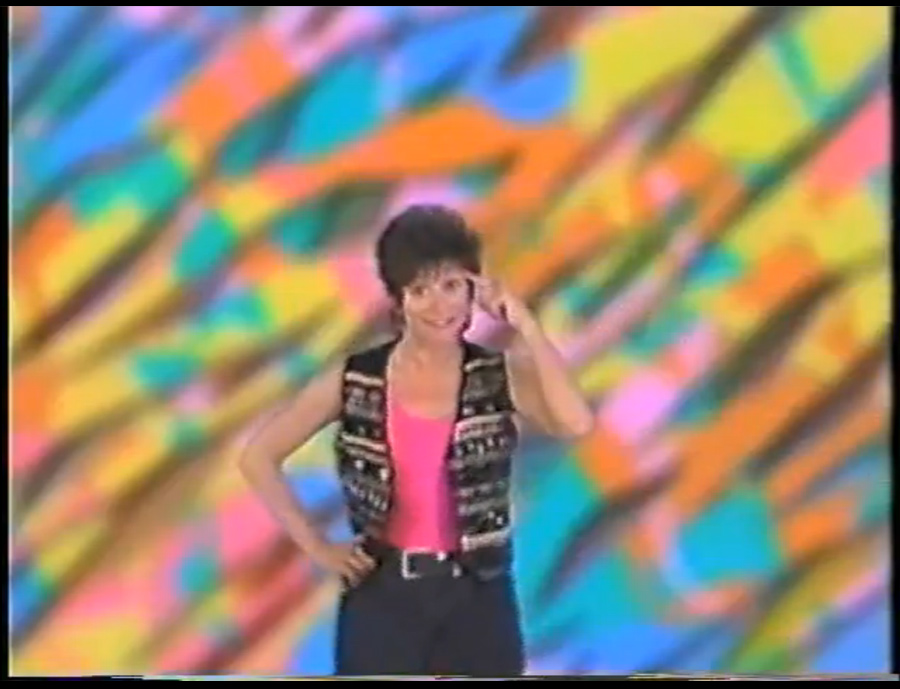
QUESTIONS OF THE AGES by Jacob Ciocci
......................................................................................................................................................
Contemporary video production is dominated by a cinematic standard of smooth edits and crisp lines. As special effects are coupled with standard editing room techniques we enter an era where the eye cannot keep pace with on-screen events. The resulting effect (speed death of the eye) is indispensable for the success of blockbuster movies and big-budget commercials. As this effect translates to the realm of personal prodution (instagram, iMovie, etc) we have the chance to reveal new logics of visual storytelling. Let's use this 'speed death' effect to probe classic conventions of video production towards a hybrid form with new intentions.
WORKSHOP ACTIVITY OUTLINE
1) pre-production (storyboard, outline, etc)
2) production (collect footage and assemble according to cinematic editing standards)
3) post-production (shatter, filter, and reassemble according to a personal standard)
......................................................................................................................................................
OVERVIEW OF CERTAIN RULES IN CINEMATIC EDITING
During the early years of cinema, film directors and editors developed many fundamental editing techniques that have become standards today. In order to provide continuity as the film develops and hundreds of shots pass by, these editing techniques signal to an audience how to understand relationships between shots and to interpret what is happening over time.
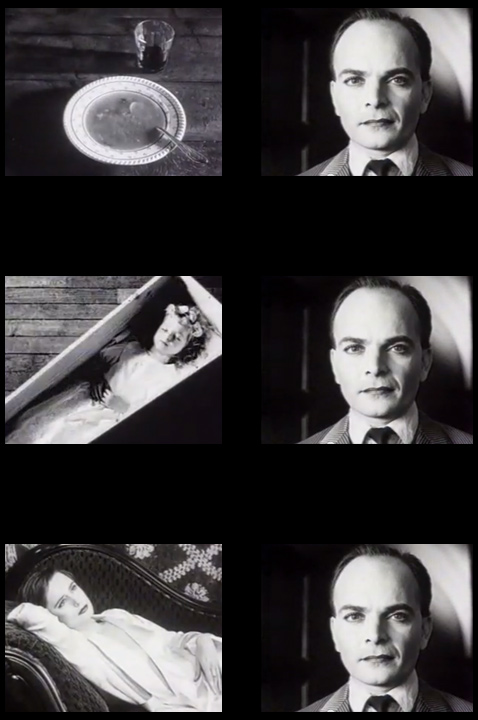
Soviet filmmaker Lev Kuleshov conducted an experiment to investigate the role of editing in viewer's understanding of what they are shown. In his experiment, shots of an actor were intercut with various evocative images to show how editing changes viewers' interpretations of the actor.
"We take a closeup of a man and cut to what he sees. And what do we show? A woman nursing a baby. You cut back to your face reaction and he smiles. Now what is he? He's a benevolent, nice gentleman.
Take away the middle piece of film (the mother and the baby) and substitute a girl in a bikini. Now he's a dirty old man. That's the purity of montage and the control of film." -Alfred Hitchcock (1970)
Below are a few of the most basic techniques of classical Hollywood editing:
Dissolve: One shot fades out as another fades in, with the result that both shots are momentarily on screen simultaneously. This is often used to suggest a connection between two shots that otherwise might seem unrelated.

Fade: A gradual transition between shots that separates the shots by a solid color fade. Fade to black is a popular way of ending a scene.


jump cut: An edit in which 2 sequential shots of the same subject from slightly varied camera positions are put together. This type of edit is often used for the effect of jumping forward in time.

Match cut: Two successive shots that get connected by some kind of visual similarity. It provides a stronger symbolic connection than a dissolve.

Shot-countershot-reaction: A form of point of view shooting. In its simplest interation, it consists of three shots: first we see a person looking; then we see what the person is seeing; finally we see the person reacting to what he/she has seen.
 ......................................................................................................................................................
TERTIUM QUID AND THE SOVIET MONTAGE THEORY
The term 'montage' in film popularly traces back to the work of Sergei Eisenstein (a pioneer in the story of cinema, especially in the realm of editing before sync-sound film). Its use survives today in the idea of 'montage sequences' inserted into Hollywood films to suggest a rapid transit in time to sum up a story. However, for Eisenstein it defined a method of filmmaking that contained discontinuity in graphic qualities, violations of editing conventions, and the creation of impossible spatial matches. It is not concerned with the depiction of a comprehensible continuity as is found in the classical Hollywood system. It draws attention to a uniquely cinematic temporal experience because changes between shots are obvious, less fluid, and non-seamless. For Eisenstein, film editing could create ideas beyond the individual images. Two or more images edited together create a "tertium quid" (third thing) that makes the whole greater than the sum of its individual parts.
For our workshop, we will employ Eisenstein's approach towards the "tertium quid" by combining appropriated video footage through classic editing conventions. To begin, open up Firefox and download the video appropriation add-on from here.